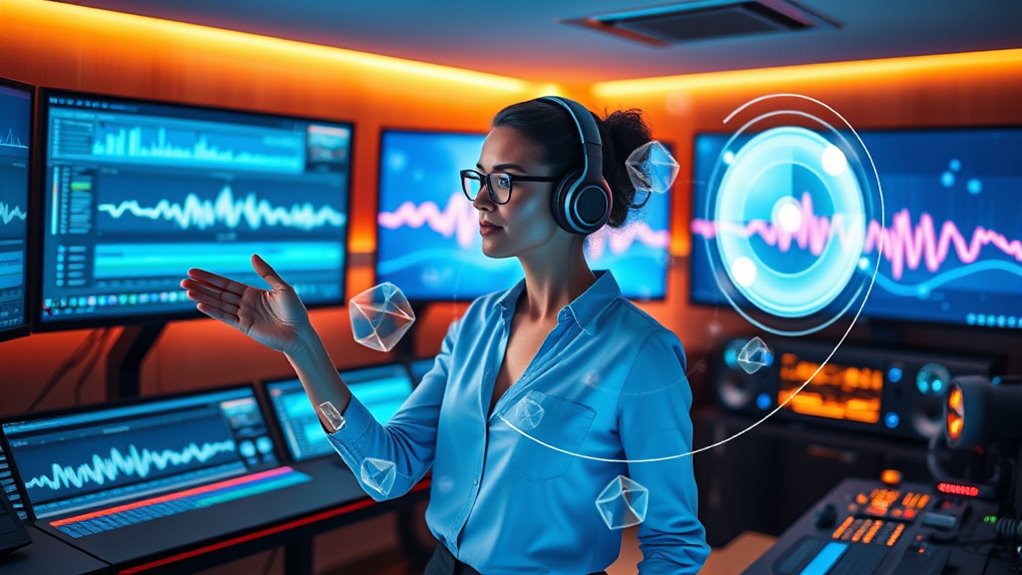

AI is transforming your film editing by automating tedious tasks, helping you work faster and more precisely. It analyzes footage to identify key moments, suggests edits, and even generates rough cuts, saving you time. AI tools also enhance creative choices by offering alternative options and improving workflows for tasks like color correction and audio balancing. As these systems learn your style, they become smarter assistants. Keep exploring to discover how these advancements can elevate your editing process even further.
Key Takeaways
- AI automates tedious editing tasks, speeding up project completion and allowing editors to focus on creative decisions.
- Machine learning analyzes footage to identify key moments, faces, and objects, enhancing organization and selection.
- Automated tools generate rough cuts, suggest transitions, and recommend effects, streamlining the editing workflow.
- AI accelerates color correction, audio balancing, and subtitle generation, improving post-production efficiency and quality.
- Integrating AI expands creative possibilities by enabling testing of multiple options and supporting iterative storytelling.
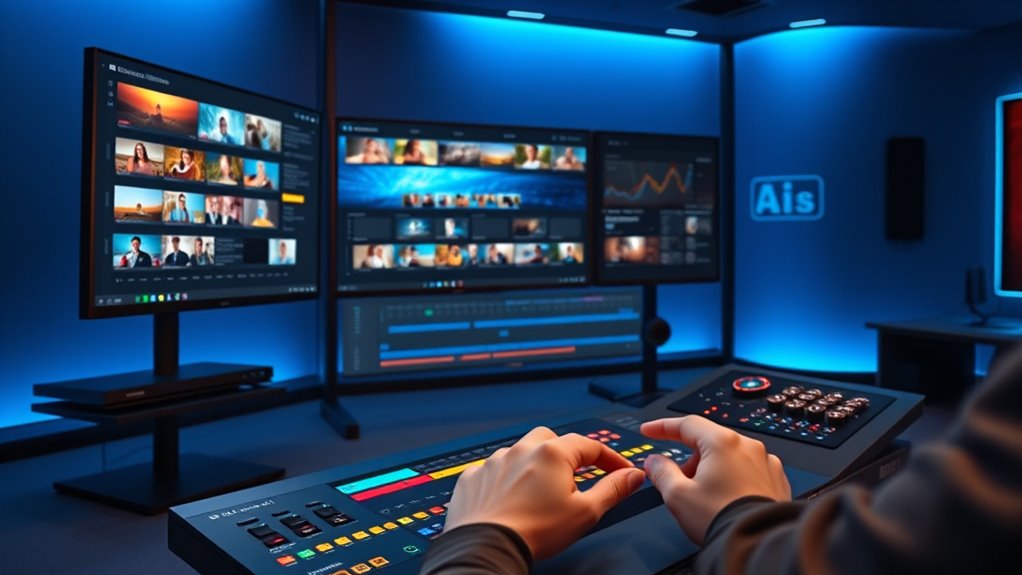
Artificial intelligence is revolutionizing film editing by streamlining workflows and enabling editors to work faster and more creatively. With the advent of AI powered tools, you now have access to a range of innovative solutions that automate tedious tasks and free up your time for more artistic pursuits. These tools leverage machine learning algorithms to analyze footage, recognize patterns, and make editing decisions that previously required hours of manual effort. Creative automation, a key aspect of this technological leap, allows you to quickly generate rough cuts, select the best takes, and even suggest transitions or effects, all with minimal input. This means you can focus more on storytelling and fine-tuning your vision rather than getting bogged down in repetitive tasks.
AI streamlines editing, automates tasks, and enhances creativity for faster, more innovative film storytelling.
As you incorporate AI into your editing process, you’ll notice how much smoother and more efficient your workflows become. For example, AI powered tools can automatically organize footage by scene, identify moments of high emotional impact, or detect specific visual elements like faces or objects. This level of automation dramatically reduces the time spent searching through hours of footage, letting you jump straight into creative decisions. Additionally, these tools can assist with color correction, audio balancing, and even generate subtitles, making the entire post-production process faster and more precise. It’s like having a smart assistant that understands your preferences and works tirelessly to execute your vision.
Creative automation also opens new possibilities for experimentation. You can test different edits, effects, or sequences without starting from scratch each time. AI can suggest alternative options based on your initial choices, encouraging you to explore creative directions you might not have considered. This iterative process accelerates your workflow while expanding your creative horizons. Furthermore, many AI tools are designed to learn from your editing style over time, becoming more personalized and effective as you use them. This continuous learning guarantees that the automation aligns with your artistic intent, enhancing your productivity without compromising your unique voice.
In essence, AI powered tools and creative automation are transforming how you approach film editing. They help you work faster, more efficiently, and more creatively, empowering you to bring your ideas to life with unprecedented ease. By embracing these technological advances, you’re not only optimizing your workflow but also pushing the boundaries of what’s possible in storytelling. The future of film editing is here, and it’s driven by AI, making your craft more innovative and rewarding than ever before. Additionally, advancements in Mazda Tuning demonstrate how automation and intelligent systems are revolutionizing industries by enhancing performance and user experience.

Love More, Fight Less: Communication Skills Every Couple Needs: A Relationship Workbook for Couples
As an affiliate, we earn on qualifying purchases.
Frequently Asked Questions
Can AI Replace Human Film Editors Completely?
AI can’t completely replace human film editors because of AI bias and the need for creative collaboration. While AI can handle tasks like sorting footage or suggesting edits, it lacks the nuanced understanding of storytelling and emotional depth that humans bring. Your creative vision depends on collaboration, where human intuition and experience guide AI tools. So, you’ll still play a crucial role, shaping the final cut with a personal touch.
How Does AI Handle Creative Decision-Making in Editing?
You might think AI handles creative decision-making alone, but it actually relies on creative collaboration with humans. AI uses algorithms to analyze footage and suggest edits, yet it lacks artistic intuition. It’s a tool that supports your vision, helping refine your ideas rather than replacing your creative instincts. Through this partnership, AI enhances your artistic choices, allowing you to focus on storytelling while it handles technical tasks.
What Ethical Concerns Arise From AI in Editing?
You should consider ethical concerns like bias mitigation and intellectual property when using AI in editing. AI may unintentionally reinforce biases or infringe on creators’ rights if not properly managed. It’s essential to guarantee transparency, respect copyright laws, and implement bias mitigation strategies. By doing so, you help maintain fairness and protect original work, fostering responsible AI use in the editing process.
How Accessible Are AI Editing Tools for Independent Filmmakers?
Imagine stepping into a vibrant editing suite where AI tools are within your reach, cutting costs and simplifying complex tasks. You’ll find many AI editing tools increasingly affordable and user-friendly, making them accessible for independent filmmakers like you. With intuitive interfaces and online resources, you don’t need a Hollywood budget to harness AI’s power, enabling you to craft professional-quality films without breaking the bank.
Will AI Impact Employment Opportunities for Traditional Editors?
AI may impact employment opportunities for traditional editors by causing some job displacement, but it also opens new roles requiring skill adaptation. You might find your job evolving as AI handles routine tasks, freeing you to focus on creative aspects. Staying adaptable and enhancing your technical skills ensures you remain valuable in the changing industry. Embrace AI as a tool that complements your expertise rather than replacing it entirely.

Communication Skills for Couples: Guide to Improve Communications, Resolve Conflict, Deepen Intimacy, Strengthen Marriage and Create a Healthy Relationship
As an affiliate, we earn on qualifying purchases.
Conclusion
As AI accelerates and automates, it’s revolutionizing the domain of film editing, making the process more precise and powerful. By blending creativity with computational control, you can craft captivating cuts quickly and confidently. Embrace this evolving evolution, and let AI be your ally in achieving artistic excellence. With technology transforming your toolkit, your talent takes center stage—turning traditional tasks into thrilling, transformative triumphs. Now, you’re ready to redefine the future of filmmaking with finesse and flair.

8-Week Couples Therapy Workbook: Essential Strategies to Connect, Improve Communication, and Strengthen Your Relationship
As an affiliate, we earn on qualifying purchases.

Couples Communication Workbook: 20 Minutes a Day for 12 Days to Improve Listening, Resolve Conflicts, and Strengthen Your Relationship (Relationship Skills Series)
As an affiliate, we earn on qualifying purchases.