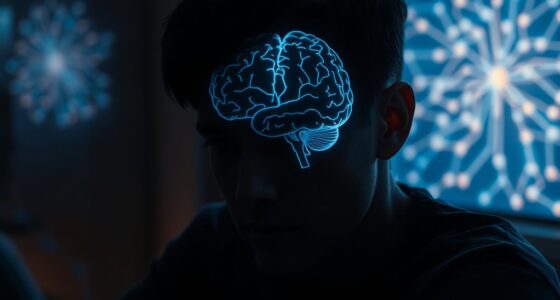


Recent advances in brain-computer interfaces (BCIs) have brought us closer to understanding neural signals associated with thoughts, emotions, and intentions. These devices can now detect subtle brain activity and translate it into commands, enabling applications like controlling prosthetics or communication for speech-impaired users. While full mind-reading isn’t possible yet, ongoing progress raises important ethical questions about privacy and manipulation. To discover how these developments could shape the future, keep exploring the exciting world of neural decoding.
Key Takeaways
- Brain-Computer Interfaces (BCIs) can interpret neural signals to decode specific thoughts and intentions, enabling direct communication with devices.
- Current technology allows reading certain neural patterns, but fully “mind reading” remains limited and not yet comprehensive.
- Advances in neural decoding improve accuracy but raise ethical concerns about privacy, data ownership, and potential misuse.
- Experts emphasize the need for regulation to prevent manipulation, coercion, and societal inequalities arising from BCI technology.
- Responsible development aims to enhance human capabilities while safeguarding mental privacy and ensuring ethical use.

Have you ever wondered how technology can directly connect with your brain? With advancements in brain-computer interfaces (BCIs), this curiosity is becoming more of a reality. These devices work by translating neural signals into commands that computers can understand, a process known as neural decoding. Essentially, they read the electrical activity in your brain, interpreting thoughts, intentions, or even emotions. This groundbreaking technology offers incredible possibilities, from restoring mobility for paralyzed individuals to enabling communication for those with speech impairments. However, it also raises significant questions about privacy, consent, and the potential misuse of such intimate data.
Neural decoding is at the core of BCIs, allowing machines to interpret your brain’s signals with ever-increasing accuracy. As sensors become more sophisticated, they can detect subtle patterns in neural activity, transforming thought into actionable commands. For example, someone might think about moving their arm, and the BCI translates that intention to control a prosthetic limb. This technology is advancing rapidly, promising to bridge the gap between human cognition and machine operation. But as you dive deeper into this domain, you must also consider the ethical implications. Who owns the neural data? How do we guarantee it isn’t exploited or used without your consent? The possibility of decoding not just actions but also complex thoughts or feelings introduces profound privacy concerns. If your brain signals can be read and interpreted, it becomes critical to establish boundaries and safeguards.
Neural decoding enables machines to interpret your brain signals; safeguarding your mental privacy is essential.
The ethical implications extend beyond privacy. As BCIs improve, there’s the risk of manipulation or coercion, especially if malicious actors gain access to neural data. Imagine a scenario where someone’s thoughts could be accessed or altered without their knowledge—this possibility sparks debates about mental autonomy and the need for strict regulations. Furthermore, the development of neural decoding technology might deepen societal divides. If only some have access to these tools, it could lead to inequalities or new forms of discrimination. As you explore these innovations, it’s essential to advocate for responsible research and clear ethical standards to protect individual rights and dignity. Additionally, diversity in design ensures that BCI technology accommodates a wide range of users with different needs and backgrounds, promoting fairness and inclusivity.
In essence, the ability to read minds through BCIs is advancing fast, promising remarkable benefits but also posing serious ethical challenges. As you consider engaging with this technology, stay aware of the importance of safeguarding your mental privacy. The future of neural decoding hinges on careful regulation and ethical oversight, ensuring these powerful tools serve humanity without compromising core values. Your awareness and advocacy will be pivotal in shaping a responsible path forward in brain-computer interface development.
As an affiliate, we earn on qualifying purchases.
Frequently Asked Questions
How Accurate Are Current Brain-Computer Interface Readings?
Current brain-computer interface readings are fairly accurate, but neural decoding still faces challenges. You might find that signal noise can interfere with precise interpretations, especially during complex tasks. Researchers have made significant progress, yet there’s variability depending on the technology and context. While some systems can decode simple commands reliably, more intricate thoughts remain difficult to accurately interpret. Overall, accuracy continues to improve, but it’s not yet perfect for reading complex mental states.
Can BCIS Detect Specific Thoughts or Emotions Reliably?
Brain-computer interfaces can detect certain thoughts and emotions through neural decoding and emotional detection techniques, but they aren’t yet reliable for pinpointing specific feelings or ideas consistently. You might feel confident that some patterns indicate particular emotions, but these readings often vary due to individual differences and complex brain activity. While progress is promising, current BCIs still have limitations in accurately and reliably decoding precise thoughts or emotional states.
What Are the Ethical Concerns Surrounding Mind-Reading Technology?
Privacy concerns and consent dilemmas dominate the debate around mind-reading technology. As you explore these innovations, you must consider how your thoughts could be exposed or exploited without explicit agreement. Ethical questions arise about who owns your mind’s mysteries and how to prevent misuse. You’re challenged to balance breakthrough benefits with safeguarding personal privacy, ensuring technology empowers rather than erodes individual autonomy and trust.
How Invasive Are the Most Effective Brain-Computer Interfaces?
The most effective brain-computer interfaces are quite invasive, requiring implant procedures that involve drilling into your skull and attaching electrodes directly to your brain tissue. You should consider implant safety carefully, as invasive procedures carry risks like infection or nerve damage. Device longevity also matters; some implants last years, while others may need replacements. Ultimately, these interfaces demand a balance between performance and invasiveness, which varies depending on your needs.
When Will BCIS Be Widely Available for Everyday Use?
Imagine a bridge connecting your mind to everyday tech—that’s how close we are to widespread BCI use. Market adoption is accelerating, but regulatory hurdles slow progress. Experts predict within 5-10 years, you might use BCIs for communication, gaming, or health monitoring. As safety standards improve, these devices will feel more natural and accessible, turning futuristic dreams into everyday realities. Patience now will open the door to a new mind-tech era.
As an affiliate, we earn on qualifying purchases.
Conclusion
As you explore the world of brain-computer interfaces, imagine your thoughts becoming open books, their pages turning with each new breakthrough. The horizon isn’t just a distant dream anymore — it’s a city skyline coming into focus. With every innovation, you’re stepping closer to a future where minds and machines dance in harmony, like stars in a constellation. The universe of possibilities is yours to embrace, igniting your curiosity and fueling your journey into the mind’s uncharted galaxy.
As an affiliate, we earn on qualifying purchases.
As an affiliate, we earn on qualifying purchases.