
TL;DR

Get gifts for the two of you delivered free with Prime
- Fast, free delivery on millions of items
- Prime Video, Amazon Music and more included
- Member-only deals all year
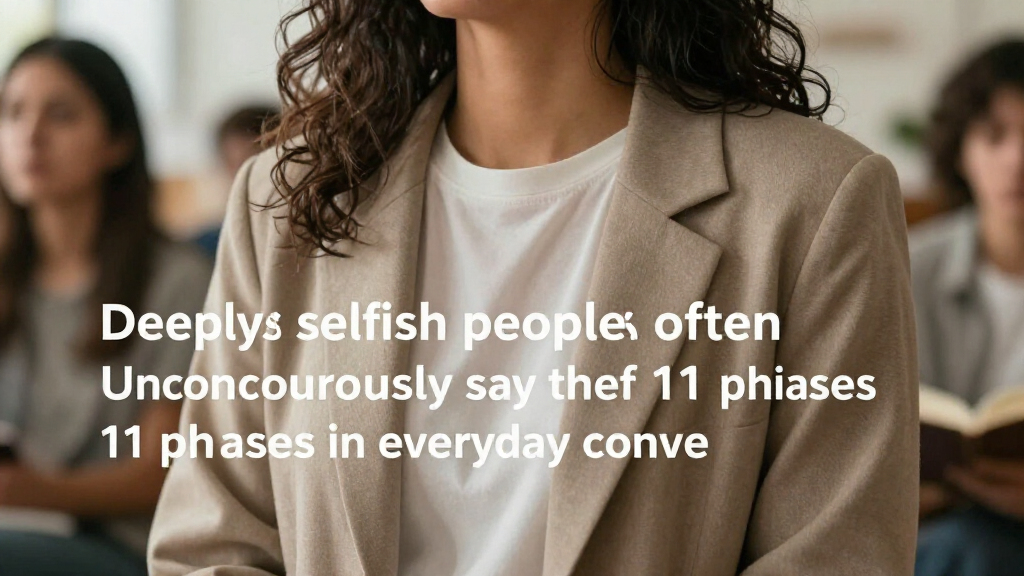
Bolde published an article identifying 11 phrases it says may reflect self-focused habits in conversation. The examples are the outlet’s interpretation, not a diagnostic test; a phrase’s meaning depends on context, intent and repeated behavior.
Bolde has published an article listing 11 phrases it says deeply selfish people may use in everyday conversation, arguing that the wording can reflect habits such as redirecting attention, avoiding responsibility or prioritizing one’s own needs. The article offers examples and interpretations, but its source material does not establish that using any phrase by itself proves someone is selfish.
The list includes phrases such as “You should’ve said something,” “I’m just being real with you” and “That reminds me of when I…”. In the supplied Bolde excerpt, the outlet interprets the first as potentially shifting responsibility onto someone who raised a concern, the second as a way to recast hurtful bluntness as honesty, and the third as a conversational pivot away from another person’s experience.
Other examples named in the excerpt include “Oh, I already ate,” “Let me finish” and “I told you so.” Bolde says these may reflect a failure to coordinate with others, an assumption that a conversation belongs to one speaker, or a preference for being right over offering comfort. These are the outlet’s interpretations of the phrases, not findings demonstrated in the material provided.
Bolde also discusses “I’m not gonna lie” before an unsolicited opinion and “No one ever does anything for me” as possible signs of self-focus or keeping score in relationships. The supplied excerpt begins describing an eighth phrase, “I deserve this,” but cuts off before explaining it or showing the rest of the list. The remaining phrases and the complete article’s supporting material are not included in the supplied source.
Why Repeated Conversation Habits Matter
For readers, the article’s practical point is that repeated conversational patterns can affect whether people feel heard, respected and supported. A person who routinely turns others’ stories back to themselves, dismisses concerns or responds to setbacks with “I told you so” may strain relationships, even if each comment seems minor on its own.
At the same time, isolated wording is weak evidence of a person’s character. Someone might say “I already ate” simply to share information, or “Let me finish” because they were interrupted. Treating a list of phrases as a reliable test could encourage readers to assign motives without enough information. The more meaningful question is whether a behavior occurs repeatedly, how it affects others, and whether the person responds constructively when it is raised.
Products Worth Considering

Withings Body Smart Wi-Fi and Bluetooth Body Composition Scale

Oura Ring 5 Smart Ring, Silver, Size 7

Garmin Forerunner 55 GPS Running Smartwatch, Black
As an affiliate, we earn on qualifying purchases.
Bolde’s Examples and Attributions
In the supplied excerpt, Bolde frames its list as a companion to visible behaviors, such as choosing plans without consulting others. The article interprets ordinary conversational phrases through their possible effects on listeners; the provided material does not present the list as the result of a new study or formal assessment.
The excerpt refers to researcher Dan Jones of the University of Nevada, Reno in connection with entitled behavior and to therapist Elizabeth Heaney in a discussion of the costs of prioritizing being right. The supplied material does not include full publication details, direct quotations from either source or enough information to independently evaluate the claims attributed to them. It also provides no research design, sample size or measurement.
What the Source Does Not Establish
The supplied Bolde excerpt does not show that the 11 phrases were identified through a clinical study, nor does it provide evidence that they reliably predict selfishness. No diagnostic standard or frequency threshold is described. The phrase “often unconsciously” appears in the article’s framing, but the excerpt does not explain how unconscious intent was assessed.
The excerpt ends partway through its discussion of “I deserve this,” so it does not reveal the complete list or the reasoning for all 11 entries. The publication date is not supplied, and the comments attributed to Jones and Heaney are not reproduced in full. As a result, the supplied material does not allow readers to assess what evidence supports Bolde’s broader generalizations beyond its examples and interpretations.
How to Read the List Carefully
The immediate next step for readers is to treat the phrases as prompts for reflection, not verdicts. Context matters: tone, circumstances, frequency and the speaker’s response to feedback can change what a remark means. If a pattern is affecting a relationship, people can describe the specific behavior and its impact rather than relying on a label.
Further evaluation of Bolde’s claims would require the complete article and the underlying sources it references. Until those materials are available, the list should be understood as Bolde’s relationship commentary, not as a validated way to identify selfish people.
Key Questions
What is the news about?
Bolde published a list of 11 everyday phrases it interprets as possible signs of self-focused behavior. The supplied excerpt contains only part of the list.
Does saying one of these phrases prove someone is selfish?
No. The provided Bolde excerpt does not establish that any phrase is a reliable test. Context and repeated behavior matter more than a single remark.
Which phrases are included in the supplied excerpt?
The supplied Bolde excerpt names “Oh, I already ate,” “You should’ve said something,” “I’m not gonna lie,” “That reminds me of when I…,” “I’m just being real with you,” “Let me finish,” “I told you so,” “No one ever does anything for me” and “I deserve this.” Its explanation of the last phrase is cut off.
Does the article cite research?
The supplied excerpt refers to researcher Dan Jones and therapist Elizabeth Heaney, but it does not give full citations or enough methodological detail to assess the claims attributed to them.
Source: bolde.com